



The inclusion of subject access points in catalog records aids users to retrieve information and to identify and locate specific resources based on subjects.
Library of Congress Subject Headings (LCSH)
- The Library of Congress' (LC's) Subject Headings Manual (SHM) provides for the establishment of Library of Congress Subject Headings (LCSH) for topical concepts/ideas, buildings, non-jurisdictional geographic names, etc., the addition of new subdivisions, cross-references, and the updating of subject authority records.
- GPO is a member of the Program for Cooperative Cataloging's (PCC’s) Subject Authority Cooperative component, SACO.
- GPO catalogers access LC subject authority records via OCLC's authority file, or via LC's Classification Web system (aka Class Web or Minaret). GPO has its own subject authority records in its Integrated Library System (ILS), Aleph. The local versions of these records are essentially the same as their counterparts in LC or OCLC. Except for cataloger codes and other minor proprietary information, GPO adds no additional information to its local versions of subject authority records.
- GPO proposes new subject authority records, and changes to existing ones, according to the instructions in the Library of Congress' Subject Headings Manual (SHM).
- With a few exceptions, such as NASA technical reports, catalogers enter LCSH in all bibliographic records. These LCSH fields are tagged 600, 610, 611, 630, 650, or 651, and coded with second indicator "0." The number of LCSH fields in a bibliographic record may vary between one and ten, but usually average between three and five. Catalogers follow SHM H 80 for the order of subject headings. When SHM H 80 does not prescribe any order, subject headings are placed in order by MARC field tag.
- Certain titles when used as subject headings do not need to be established. See: SHM H 1435, and: DCM Z1: Introduction: Name authority records (NARs): bullet numbered (3) under "For titles or name/titles," the converse of the second phrase. Otherwise, all subject headings entries and subject heading subdivisions appearing in GPO records must be confirmed in the OCLC authority files, or by a subject heading proposal in the Library of Congress’ Classification Web system. This includes all subjects and names used as subjects (personal names, corporate/conference names, uniform titles, and jurisdictional geographic names) that appear in the 6XX fields of bibliographic records. A temporary exception may be made for Congressionals or other priority titles, when names used in these as subjects (fields 600, 610, or 611) are in the process of having NACO records prepared.
- Catalogers are responsible for correctly assigning and recording subject added entries in the 600, 610, 611, 630, 650, and 651 fields. These must be authorized in the OCLC authority files, and follow SHM instructions. Catalogers should additionally follow instructions in the other sources cited below. If a subject heading is needed for the resource cataloged, that is not found in OCLC's subject authority file, or if the heading is found but requires additional authority work, such as the addition of cross-references, the cataloger creates a new or change subject proposal in LC's Classification Web system, following SACO procedures. If catalogers are not sure whether to make a proposal or not, they should ask the SACO liaison first, before beginning any work.
GPO practice: the new proposed subject heading may be entered in the bibliographic record before being approved by LC, as long as the record is not authenticated. For more details, see: Subject Cataloging: Subject Heading Proposals, Workflow: Producing Associated Bib Records; Exporting Subject Authority Records. Note: section E5.5: Subject Headings (page 21) of the BIBCO Participants’ Manual allows proposed new subject headings in authenticated BIBCO records.
GPO catalogers consult the sources listed below for instructions on subject heading assignment, checking and revising subject headings in existing records, and the proposing of new and changed subject authority records needed for subject cataloging.
The primary sources consulted are:
- SHM Subject Headings Manual
- LCSH (Library of Congress Subject Headings) via Classification Web (Class Web) or Minaret
- SACO Participant's Manual
- Basic Subject Cataloging Using LCSH
- Library of Congress Subject Headings: Online Training
- Janis Young's "Assigning Library of Congress Subject Headings Webinar: Handout" (GPO internal training material)
- Janis Young's "Assigning Library of Congress Subject Headings Webinar: Exercises" (GPO internal training material)
NASA Thesaurus Terms as Subject Headings
For publications assigned NASA technical report SuDocs numbers (NAS 1.15:, NAS 1.26:, NAS 1.12/2-2:, NAS 1.60:), GPO assigns subject headings from the NASA Thesaurus. The NASA Thesaurus is available as an alphabetical listing of authorized NASA subject terms in searchable PDF format at https://sti.nasa.gov/nasa-thesaurus/. Until 2020, NASA assigned NASA Thesaurus terms to records for technical publications available on the NASA Technical Report Server (NTRS). NTRS is a public database of current and historical NASA technical literature available at https://ntrs.nasa.gov. NASA ceased assigning NASA subject terms in 2020.
Assigning NASA Terms
Sources
The cataloger may utilize one or more of the following sources to assign NASA Thesaurus subject terms (NASA terms) to the record for a NASA technical report found in NTRS:
- The report “landing” page from which the document may be downloaded, specifically:
- The abstract, if available
- “Subject Category” term or terms if available
- “Keywords” if available
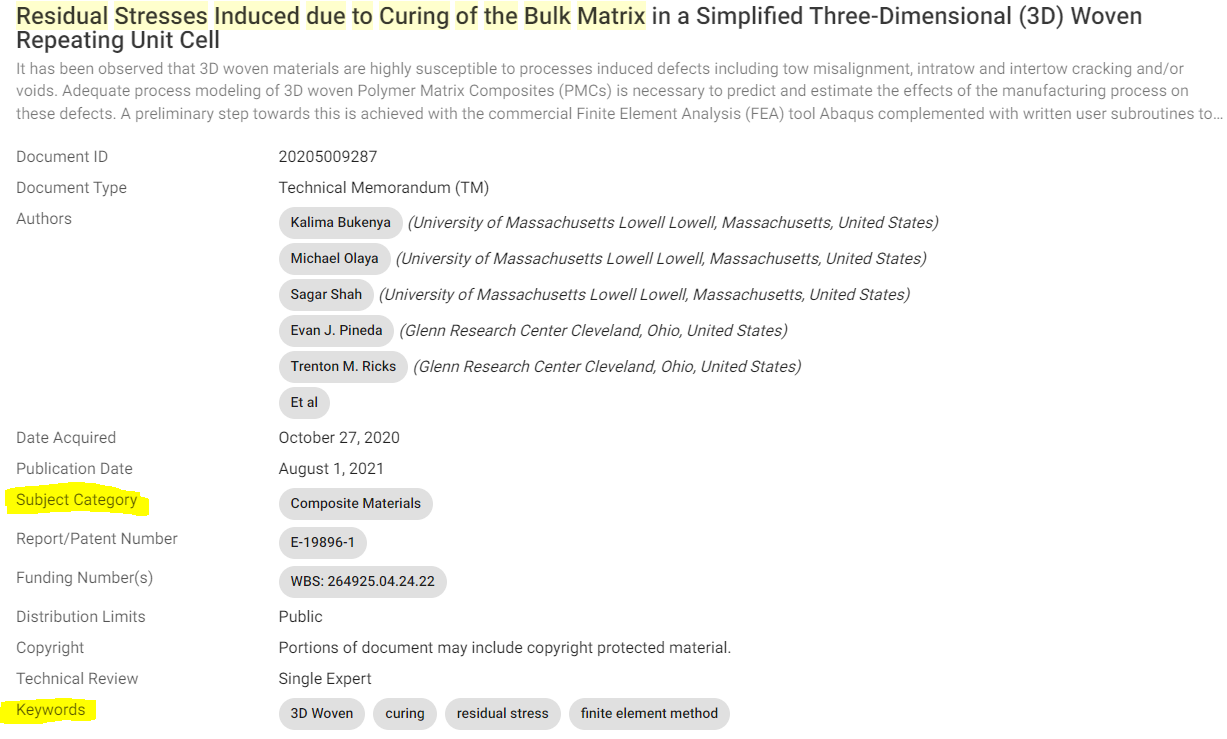
- The downloaded PDF report itself, especially the abstract.
Procedures
Retrieving Relevant Terms
The cataloger searches terms from the above sources in the NASA Thesaurus (volume 1 is recommended), in order to identify authorized NASA terms. Following are some tips:
- Searching the NASA Thesaurus:
- Using volume 1, familiarize yourself with the Introduction, including the sections: Cross Reference Structure and Typical Hierarchical Listing with Definition.
- When searching for a term, you may browse the alphabetically arranged list, or use a “Find” search.
- Authorized terms “are shown in non-italic type,” while unauthorized terms “are set in italics.” Consequently, when using a “Find” search, you may be assured that a desired term entered as a reference is authorized as long as it is not italicized.
- Do not use italicized terms.
- Use of “Subject Category” terms from the report “landing page”:
- These terms are too broad to retrieve specific NASA terms.
- However, locate such terms in the NASA Scientific and Technical Information Scope and Subject Category Guide (aka NASA Scope and Subject Category Guide).
- Broad categories are listed in the table of contents, with more specific categories underneath.
- Either browse the table of contents or index, use a “Find” search, or any combination of these.
- When you reach a page for one of the Subject Categories numbered 1-99, you will see a list of narrower terms labeled Input Subjects of Specific Interest.
- Select those that appear relevant to the report, then
- Search those terms in the NASA Thesaurus
- This will hopefully lead you to relevant authorized terms
- Use of “Keywords” from the report “landing page” and/or keywords identified in the abstract:
- While it is most likely best to search these terms directly in the NASA Thesaurus, the cataloger may wish to experiment with first searching these terms in the NASA Scope and Subject Category Guide.
- Thus, in some cases, a combination of searching both sources may prove effective.
Recording the Terms in the Bibliographic Record
The terms are then transcribed as 650 subject headings in the corresponding OCLC record, following standard Library of Congress subject heading capitalization practice, and coded as NASA Thesaurus headings (i.e. second indicator "7" and subfield "2" followed by "nasat").
Example
650 _7 Boundary layers. ǂ2 nasat
General Policies and Procedures
Multiparts
Multipart NASA technical reports may contain separate records for each part in NTRS. If using a single catalog record for the overall multipart, and the individual parts vary substantially in subject content:
- use the procedures above to identify NASA terms to each part, then:
- combine all these terms in the single bibliographic record.
Use of Library of Congress Subject Headings (LCSH)
For bibliographic records for NASA technical reports:
- LCSH may be included if the report is not found in NTRS.
- When updating an existing OCLC record that contains LCSH, retain the LCSH in OCLC and in the CGP.
PCC Authentication
Because NASA Thesaurus headings meet the PCC standard of being derived from a "recognized thesaurus," catalog records containing these headings are eligible for PCC authentication, provided that the records meet all other PCC standards.
MESH, NAL, and Other Non-LC Subject Headings
The National Library of Medicine (NLM) and National Agricultural Library (AGL) maintain their own subject thesauri for use in their cataloging work. The headings are coded in the 6XX Marc field as:
- Medical Subject Headings (MESH): second indicator "2"; and
- National Agricultural Library Subject Authority File (NAL): second indicator "3".
When encountered during copy cataloging, GPO retains these headings for the CGP only when there is clear indication that they were entered by NLM or AGL (i.e., NLM or AGL appear in a 040 subfield). MESH and NAL headings meet the BIBCO standard of being derived from "a recognized thesaurus" and bibliographic records containing such headings are eligible for upgrade to PCC status, provided that the record meets all other PCC standards and NLM or AGL appear in a 040 subfield. GPO never verifies or authorizes NLM or AGL headings; they are merely removed or retained locally, per the guideline above. (Since 2022, MESH headings have undergone authority control processing by the current service provider.)
Other non-LC subject headings may be retained in an OCLC record, but are not included in the corresponding CGP record.